|
FCI-Standard N° 250 /
Havanese(Bichon Havanais) |
 |
|
TRANSLATION : Mrs. Peggy Davis.
ORIGIN : Western Mediterranean basin, development : Cuba.
PATRONAGE : F.C.I.
DATE OF PUBLICATION OF THE ORIGINAL VALID STANDARD : 10.12.1996.
UTILIZATION : Companion and toy dog.
CLASSIFICATION F.C.I. : Group 9 Companion and Toy Dogs. Section1 Bichons and related breeds. Without working trial.
BRIEF HISTORICAL SUMMARY : The breed comes from the Western Mediterranean region and has developed along the Spanish and Italian coastal region. It would seem that these dogs were imported early in Cuba by ocean navigating Italian captains. Erroneously, the most frequent brown colour of these dogs (tobacco) gave birth to the legend which would mean it to be a breed originating from Havana, capital of Cuba. The political events however have led to the total disappearance of the old blood lines of the Havanese in Cuba; apparently a few dogs could be successfully smuggled out from Cuba; their descendants have survived in the U.S.A.
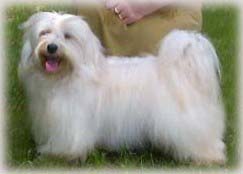
GENERAL APPEARANCE : The Havanese is a sturdy little dog, low on his legs, with long abundant hair, soft and preferably wavy. His movement is lively and elastic.
IMPORTANT PROPORTIONS : The length of the muzzle (tip of nose to stop) is equal to the distance between the stop and the occipital protuberance. The relation between the length of the body (measured from the point of the shoulder to the point of the buttock) and the height at the withers is of 4/3.
BEHAVIOUR / TEMPERAMENT : Exceptionally bright he is easy to train as alarm dog. Affectionate, of a happy nature, he is amiable, a charmer, playful and even a bit of a clown. He loves children and plays endlessly with them.
HEAD : Of medium length, the relation between the length of the head and that of the trunk (measured from the withers to the base of the tail) is of 3/7.
CRANIAL REGION : Skull : Flat to very slightly rounded, broad; forehead hardly rising; seen from above it is rounded at the back and almost straight and square on the other three sides. Stop : Moderately marked.
FACIAL REGION : Nose : Black. Muzzle : Narrowing progressively and slightly towards the nose but neither snipey nor truncated. Lips : Fine, lean, tight. Jaws/Teeth : Scissor bite. A complete dentition is desirable. The absence of premolars 1 (PM1) and molars 3 (M3) is tolerated. Cheeks : Very flat, not prominent. Eyes : Quite big, almond shape, of brown colour as dark as possible. Kind expression. The eyes rims must be dark brown to black. Ears : Set relatively high; they fall along the cheeks forming a discreet fold which raises them slightly. Their extremity is in a lightly rounded point. They are covered with hair in long fringes. Neither propeller ears (sticking sideways), nor stuck to the cheeks.
NECK : Of medium length.
BODY : The length of the body is slightly superior to that of the height at the withers. Back : Topline straight, slightly arched over the loin. Croup : Noticeably inclined. Ribs : Well sprung. Belly (abdomen) : Well tucked up.
TAIL : Carried high, either in shape of a crozier or preferably rolled over the back; it is furnished with feathering of long silky hair.
LIMBS
FOREQUARTERS : Forelegs straight and parallel, lean; good bone structure. The distance from the ground to the elbow must not be greater than that between the elbow and the withers.
HINDQUARTERS : Good bone structure; moderate angulations.
FEET : Of slightly elongated shape; small; tight toes.
GAIT / MOVEMENT : According to his happy nature, the Havanese has a strikingly light-footed and elastic gait; forelegs with free stride and pointing straight forward, the hindlegs giving them the impulsion and moving in a straight line.
COAT
HAIR : Undercoat woolly and not very developed; it is often totally absent. The topcoat is very long (12-18 cm in an adult dog), soft, flat or wavy and may form curly strands. All grooming, the usage of scissors to even out the length of the coat and all trimming is forbidden. Exception : tidying up the hair on the feet is permitted, the hair on the forehead may be slightly shortened so that it does not cover the eyes and the hair on the muzzle may be slightly tidied up, but it is preferable to leave it in natural length.
COLOUR : There are two varieties of colour : · Rarely completely pure white, fawn in its different shades of light fawn to havana-brown (tobacco colour, reddish brown); patches in those colours of coat; slight blackened overlay admitted. · Admitted colours and patches (white, light fawn to havana-brown) with black markings. Black coat.
SIZE : Height at the withers : from 23 to 27 cm.
Tolerance : from 21 to 29 cm. |